
CPQ for Business Leaders: Do You Need Simple, Standard, or Complex?
At Novus CPQ, I’ve had a lot of conversations with manufacturers, software vendors, and service providers about Configure–Price–Quote (CPQ).
When we start talking about a new CPQ project, customers often say some version of this:
“We know our products and our customers. We don’t know CPQ. We just want something that fits.”
At the same time, vendors talk about “advanced configuration,” “AI pricing,” or “enterprise quoting.” Internal teams ask whether you need “complex rules” or “dynamic approvals.” None of that is very helpful if you’re a business leader trying to answer a much simpler question:
What level of CPQ do we actually need?
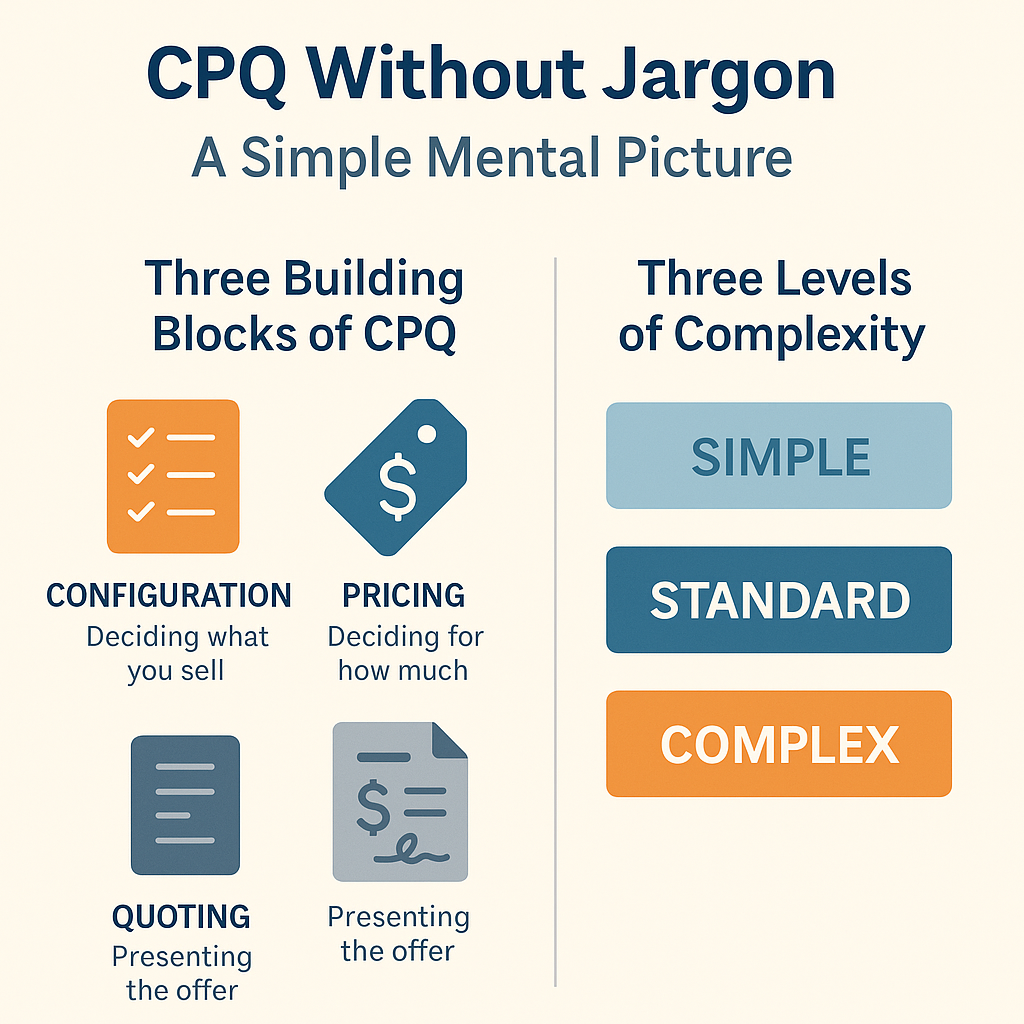
This article is my attempt to answer that in plain business language. I’ll use a simple structure I often use in briefings and workshops:
- Three building blocks of CPQ
- Configuration– deciding what you sell
- Pricing– deciding for how much
- Quoting– presenting the offer so a customer can say “yes”
- Three levels of complexity
- Simple
- Standard
- Complex
By the end, you should be able to say something like:
“For configuration we’re simple, for pricing we’re standard, and quoting is where things get complex.”
That level of clarity is a very good starting point for any CPQ selection or project.
1. CPQ Without Jargon: A Simple Mental Picture
Forget systems for a moment and think about what actually happens when someone in your organization creates a quote.
Whether it’s an internal sales rep, a partner, or a key account manager, they have to do three things:
- Decide what to offer: which product, which options, which services, which terms.
- Decide what to charge: list prices, discounts, maybe rebates or contract conditions.
- Turn all of that into a quote or proposal the customer can understand and approve.
This is all CPQ is trying to support:
- A product configurator to help define what you’re selling
- A pricing engine to help calculate and control prices
- A quoting engine to help package everything into a clear offer
In many companies, these steps currently live in Excel files, emails, and people’s heads. A CPQ tool doesn’t change what you’re trying to do – it changes how predictable and scalable it is.
With that picture in mind, we can talk about what “simple,” “standard,” and “complex” look like in each area.
2. Simple, Standard, or Complex – What’s the Difference?
When I ask customers whether their CPQ needs are simple, standard, or complex, they often answer “complex” by instinct.
Then we look closer, and the picture becomes more nuanced:
- Some have fairly simple products, but complicated pricing.
- Others have very complex configurations, but fairly straightforward quoting.
- Some are “simple” in all three and just want to get out of spreadsheets.
Here’s a practical way to think about the three levels:
- Simple: you want to avoid obvious errors, move away from manual work, and give sales a bit of structure.
- Standard: you want consistent behavior across regions, channels, and product lines. You want rules instead of one-off exceptions.
- Complex: your configuration, pricing, or quoting processes are heavily intertwined with engineering, finance, legal, or manufacturing – and they are part of your competitive edge.
You don’t need to pick a single label for the whole business. It’s perfectly normal to be, for example:
- Simple in configuration
- Complex in pricing
- Standard in quoting
The important thing is to understand where you are in each building block.
3. Product Configuration: How Hard Is It to Define “What We Sell”?
Let’s start with configuration, because that’s often the first pain point people mention.
Simple configuration: avoiding the “we forgot something” scenarios
In a simple configuration situation, your sales team typically starts with a small set of base products and adds a few options: size, color, performance level, warranty, maybe some accessories.
Most of the know-how lives in people’s heads or in old slide decks:
- “Remember to add the adapter for that version.”
- “We don’t offer that combination in this region.”
- “If you’re not sure, ask someone in engineering.”
The main risk is not technical complexity; it’s human error. People forget mandatory options. They propose combinations that don’t exist in the ERP. They promise something the warehouse doesn’t stock.
A simple configurator helps by guiding users through a logical sequence of choices and quietly blocking impossible combinations. It doesn’t try to replicate engineering. It simply stops the “we can’t build what you just sold” conversation.
If most of your quotes have a relatively small number of line items and engineering doesn’t spend much time correcting sales configurations, you’re probably in the simple camp for configuration.
Standard configuration: from individual SKUs to “solutions”
As the portfolio grows, many companies move into what I would call standard configuration.
You’re no longer selling a single product plus an add-on. You’re selling solutions: hardware plus services, a machine plus software and training, a bundle with optional extras, maybe with regional variations.
Now the configurator has to do more than just stop errors. It should help design a coherent solution:
- The right base product
- Appropriate options and accessories
- The recommended services or maintenance
- Rules that differ by region, channel, or customer segment
You want a new sales rep or partner to be able to build a sensible solution without needing an engineer on every call.
If you find yourself talking internally about “systems,” “solutions,” or “packages” rather than individual products, and if engineering regularly double-checks what sales sells, you’re likely closer to standard than “simple” on the configuration side.
Complex configuration: configuration as part of engineering
In some businesses, configuration isn’t just a sales exercise. It’s part of engineering and manufacturing.
Typical examples are industrial equipment, large systems, and engineer-to-order products. Here, each configuration decision has technical, regulatory, and sometimes safety implications.
A complex configurator in that environment might:
- Calculate dimensions, loads, and performance
- Generate bills of material that go straight into manufacturing
- Integrate with CAD or PLM to produce models and drawings
In other words, configuration and engineering are deeply connected.
If your standard process today is “sales proposes something, then engineering validates and adjusts it every time,” your configuration complexity is probably high, at least for part of your portfolio. That has direct implications on what you should expect from a CPQ tool.
4. Pricing: How Hard Is It to Decide “For How Much”?
The second building block is pricing. This is often where internal tensions show up: sales, finance, and management rarely see pricing in exactly the same way.
Simple pricing: getting out of the “spreadsheet wild west”
In a simple pricing environment, you typically have one or a few central price lists and fairly straightforward discounts. The core issue is not the formula; it’s control.
You might recognize some of this:
- Reps export prices from ERP and adjust them in Excel.
- Discounts are negotiated ad hoc.
- Margin checks and approvals are manual and inconsistent.
A simple pricing engine consolidates this. It manages list prices, lets sales apply basic discounts, and triggers approvals when certain thresholds are exceeded. It brings structure without turning pricing into a science project.
If your primary concern is, “we need fewer surprises and less creative pricing,” then you’re squarely in the simple category for pricing.
Standard pricing: turning informal habits into explicit rules
In many organizations I speak with, pricing practices have evolved over time:
- Certain regions are more competitive and need different price levels.
- Distributors get different discounts than end-customers.
- Small orders, rush orders, or specific product categories behave differently.
In a standard pricing setup, you decide to formalize these patterns:
- Separate price lists for regions, customer types, or channels
- Clear rules for discounts and surcharges
- Margin visibility on quotes
- Approval thresholds when someone wants to go beyond normal ranges
A standard pricing engine helps you express these rules cleanly and apply them consistently. It doesn’t mean every deal is rigid. It means you know what “normal” looks like, and you see when someone wants to go outside of that.
If your pricing discussions sound like “we all sort of know the rules, but they’re not written down anywhere,” then you’re probably ready for standard pricing capabilities.
Complex pricing: contracts, rebates, and analytics
Then there is the group for whom pricing is almost a discipline of its own.
In a complex pricing world, you might have:
- Customer or project-specific contracts with special prices
- Promotions that change by period or product mix
- Rebates based on volume, growth, or product mix
- Escalation clauses tied to indices or inflation
When that’s the case, a single quote can be influenced by multiple layers of logic: base price list, contract price, promotional terms, expected rebates, and so on. Some companies also bring analytics or AI into the picture to suggest target prices or check whether a deal is in a “win-win” range.
Here, a pricing engine has to juggle precedence between rules, keep track of the financial impact, and help you avoid unpleasant surprises later.
If you have dedicated teams managing special pricing, talk about “pocket margin,” or cannot easily answer “what happens if we adjust this policy globally?”, then you’re operating in complex pricing territory.
5. Quoting: How Hard Is It to Present a Clear, Professional Offer?
The third building block is quoting: the form sales fills out and the document the customer receives.
Simple quoting: consistent, clean, and not embarrassing
Quite a few companies I speak with are still in what I’d call simple quoting mode.
They usually have:
- Several versions of old Word or Excel templates
- Inconsistent branding and formatting
- Different levels of detail depending on who created the quote
The core pain point is embarrassment: “We don’t look as professional as we should, and we waste time formatting documents.”
A simple quoting capability solves that by standardizing:
- The basic quote structure (header, line items, totals)
- The look and feel (logo, fonts, colors)
- Basic statuses (draft, sent, accepted, expired)
If your main goal is to stop sending messy PDFs and have a consistent face to the customer, you’re in the simple quoting category.
Standard quoting: from quote to mini-proposal
As deals get bigger or more strategic, quotes often turn into small proposals.
You might have:
- Separate sections for hardware, software, and services
- Different templates for different regions or brands
- Standard terms and conditions, with some variation by country or product
- Optional scenarios that let the customer choose between alternatives
- E-signature integrated into the process
In a standard quoting setup, you want to assemble these documents quickly, without every salesperson reinventing the wheel. You also want a clear history of what was sent and what was accepted.
If you often work on multi-page proposals, care about a polished customer experience, and are tired of manual version management, you’re firmly in standard quoting territory.
Complex quoting: quotes that behave like contracts
Finally, there are companies where a “quote” for large deals looks more like a contract draft.
You may see:
- Multiple legal entities or countries in one deal
- Detailed schedules, service levels, and annexes
- Heavy involvement from legal, finance, and sometimes engineering
- Several rounds of redlining and negotiation with the customer
A complex quoting environment requires more than standard templates. You need dynamic assembly of clauses, good version control, and often integration with contract lifecycle tools.
If sending a quote on a major deal feels like running a mini-project involving several teams, then at least part of your business has complex quoting requirements.
6. Putting Your Business on the Map
At this point, the key question is: where do you sit today?
You don’t need a perfect answer. A rough, honest answer is enough to move forward.
A simple exercise I often suggest is this:
- Take three to five real deals from the past year – ideally a mix of small, medium, and large.
- For each one, ask:
- Where did we struggle most: configuration, pricing, or quoting?
- What caused delays or rework?
- What made the deal riskier or more painful than it should have been?
- Then, for each building block, ask yourself:
- Are we behaving more like simple, standard, or complex here?
You might end up with something like:
- “For configuration, we’re mostly simple; a standard level would give us more control.”
- “Pricing is already complex due to contracts, rebates, and different regions.”
- “Quoting is simple today, and that’s okay for now.”
That kind of statement is extremely helpful when you talk to vendors, partners, or your internal IT team. Instead of saying “we need advanced CPQ,” you can say:
“We need standard configuration, complex pricing, and standard quoting – and here’s why.”
It’s a very different conversation.
7. You Don’t Have to Be a CPQ Expert
The main message I want to leave you with is this: you don’t need to understand every last feature of every CPQ tool. That’s not a good use of your time.
What you do need is a structured way to describe your world:
- How hard is it to define what we sell?
- How hard is it to decide for how much?
- How hard is it to present an offer our customers can say “yes” to?
If you can roughly classify your needs as simple, standard, or complex in configuration, pricing, and quoting, you’re already ahead of many organizations that jump into CPQ with no such clarity.
From there, you can:
- Filter out solutions that are obviously overkill.
- Avoid tools that look inexpensive but won’t support your real complexity.
- Build a sensible roadmap: start where the pain is highest and keep the door open for future growth.
If you’re planning a CPQ project in the next 6–18 months, taking an hour with a few colleagues to walk through recent quotes using this framework is time very well spent. The patterns you see in your own deals will tell you more about your CPQ needs than any vendor demo.
If you’re currently shortlisting vendors and need to know which ones handle “complex pricing” or “simple configuration” best, the Novus CPQ Briefing Subscription can help with that next step. It offers vendor-neutral analysis of leading CPQ solutions, so you can match your maturity level to the right software instead of starting from a blank page. Learn more at https://novuscpq.com/cpq-briefing-subscription/
Leave A Comment